(1) IEC Standards
Standards developed by the International Electrotechnical Commission (IEC) do not have legal force on their own. However, they are often used as the foundation for mandatory national standards in many countries. Representative examples include standards such as IEC 62368‑1 and IEC 60601‑1.
(2) CE/UKCA marking
CE marking is mandatory for machinery and electrical products sold within the EU, as it indicates compliance with requirements related to safety, quality control, and environmental protection.
Starting January 1, 2021, the United Kingdom introduced the UKCA marking system, which replaces CE marking within the UK.
To comply with these regulations, products must meet the relevant directives and regulations.
Our company provides Declarations of Conformity based on the Low Voltage Directive/Electrical Equipment (Safety) Regulations and the RoHS Directive/RoHS Regulations.
Below are representative directives and regulations.
a. Machinery Directive / Supply of Machinery (Safety) Regulations
The Machinery Directive applies to the safety of machines equipped with moving parts, such as machine tools and industrial robots.
This directive has been in effect since January 1995.
b. EMC Directive / Electromagnetic Compatibility Regulations
The EMC Directive includes two categories of requirements: EMI (Electromagnetic Interference) and EMS (Electromagnetic Susceptibility). It applies to all electrical and electronic devices, including equipment and installations that contain components considered capable of generating electromagnetic disturbances.The directive has been in force since January 1996.
Below are the requirements for EMI and EMS respectively.
- *For the residential, commercial and light industrial environment:
Emission : EN61000-6-3
Immunity : EN61000-6-1 - *For the industrial environment:
Emission : EN61000-6-4
Immunity : EN61000-6-2
Standards are defined for product categories and individual products, including information technology equipment.
Although standards such as EN55022 address high‑frequency noise, actual products must also meet requirements related to low-frequency noise, including harmonic currents.
Under the EMC Directive, all of these requirements must be fulfilled. Therefore, conformity is assessed based on common standards that encompass all relevant requirements.
c. Low Voltage Directive / Electrical Equipment (Safety) Regulations
The LVD applies to products operating at low voltage, specifically those that operate within the ranges of AC 50–1000 V and DC 75–1500 V.
This directive has been in effect since January 1997.
(3) JEITA Standards
JEITA standards were established as industry criteria by the Committee of Switch mode Power Supply of the Japan Electronics and Information Technology Industries Association. General standards, specific standards, test methods, and terminology, etc. are included, but there is no enforcement power.
(4) RoHS Directives
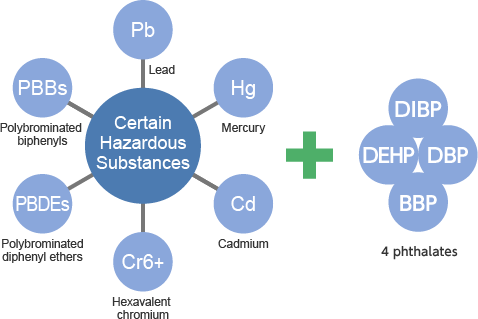
The RoHS Directive came into force on July 1, 2006, restricting the use of six specific hazardous substances: mercury, lead, cadmium, hexavalent chromium, PBB, and PBDE.
Subsequently, the revised RoHS2 Directive (2011/65/EU) expanded the scope of regulated products and introduced CE marking as an additional requirement.
In June 2015, four phthalate substances (DEHP, BBP, DBP, and DIBP) were added, bringing the total number of restricted substances to ten as of July 22, 2019.