(1) What is Noise?
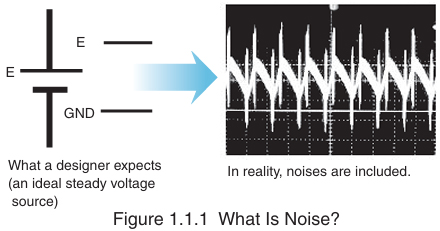
Noises refer to unwanted variations or disturbances in voltage, current, signals, and so on.
(2) Noise Sources
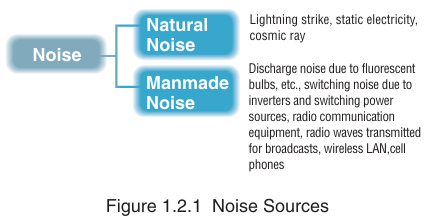
Noise can be generated by both natural phenomena and man-made equipment.
Natural sources include lightning and electrostatic discharge, while man-made sources include industrial equipment and lighting devices, as well as communication equipment that intentionally emits electromagnetic waves.
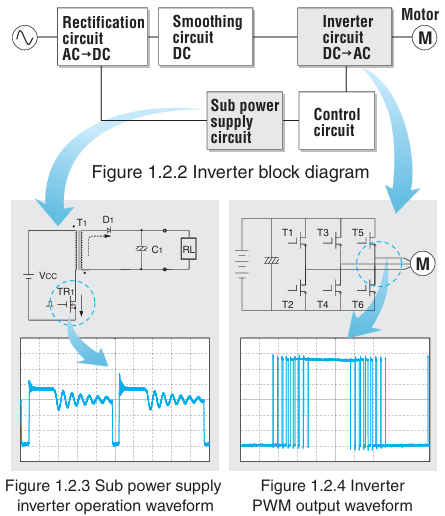
Typical devices that generate noise include switching power supplies and general-purpose inverters. These devices contain switching elements such as FETs and IGBTs, whose high-frequency switching operation makes them major sources of noise.
(3) What is EMC?
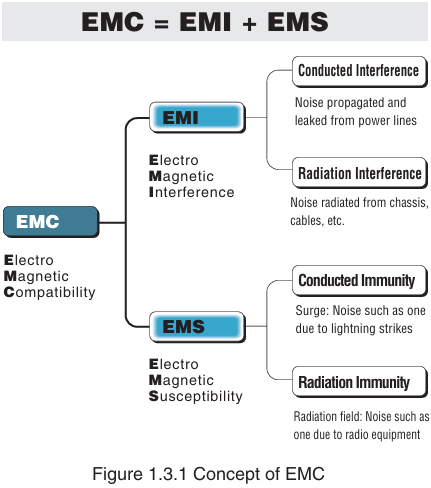
EMC stands for electromagnetic compatibility and refers to the ability of electrical equipment to both suppress noise it emits (EMI) and withstand noise coming from external sources (EMS).
What are EMC compliant products?
EMC-compliant products are those that meet the requirements of both EMI and EMS standards.
A variety of components is available to address noise issues from the EMI and EMS perspectives.
Our EMI filters are primarily designed to suppress conducted interference related to EMI.
(4) Propagation Paths of Noise
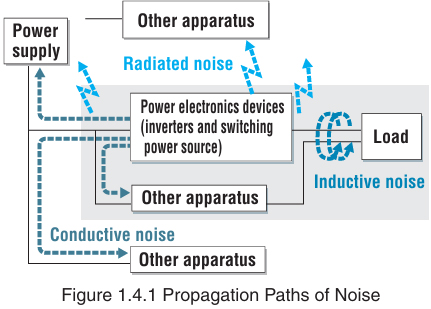
a. Conductive noise
Noise that propagates through power lines or PCB traces
b. Inductive noise
Noise that is induced through electromagnetic or electrostatic coupling when a power line or signal line of a peripheral device is placed near a line or PCB trace carrying noise current.
c. Radiated noise
Noise that is radiated from an antenna-or from a line behaving as an antenna-and propagates through the air to other devices.
(5) Basics of Noise Reduction
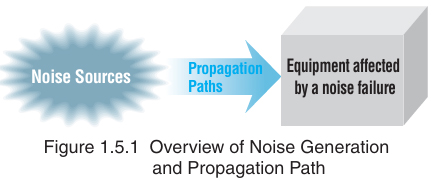
The propagation of noise involves three elements: a noise source, the device affected by the noise, and the propagation path that connects them. To reduce noise, the following basic approaches are used:
- Reduce the noise level at the source
- Make it more difficult for noise to propagate
- Increase the noise immunity of the equipment
In addition to these basic principles, noise-reduction design must also take into account applicable standards, quality requirements, and cost considerations.
(6) Types of Conductive Noise
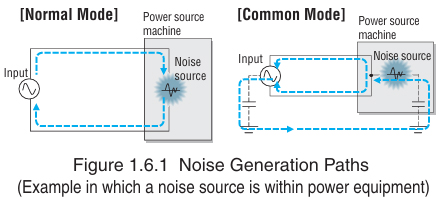
Noise can be classified into two types based on its mode of generation: normal-mode noise and common‑mode noise. Normal‑mode noise, also called differential‑mode noise, appears between the power lines. Common‑mode noise occurs between the power lines and ground.
(7) Types of and Countermeasures for Noise
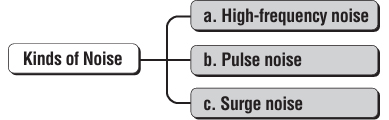
a. High-frequency noise
Also referred to as EMI noise or power-supply noise, it consists of high-frequency components such as a computer’s clock frequency and the switching frequency of power supplies. As a countermeasure, an EMI filter should be installed on the input side. The appropriate filter should be selected based on required attenuation, mechanical constraints, and cost.
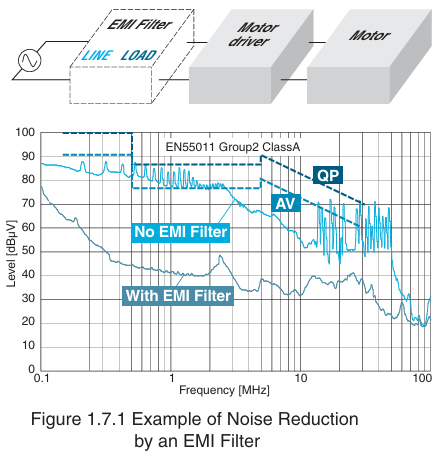
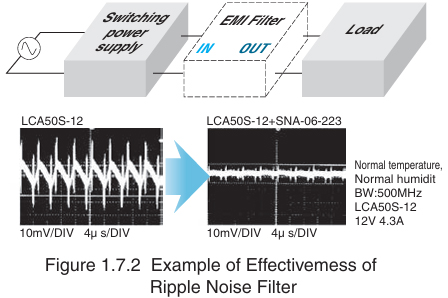
Output ripple noise from a switching power supply is also a type of high-frequency noise. This ripple noise can be reduced using a DC filter designed for that purpose.
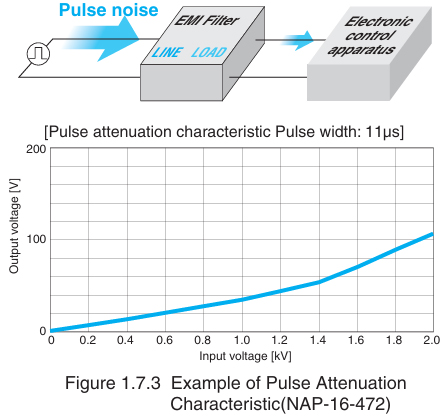
b. Pulse noise
This type of noise is generated when a relay or motor is driven. Because the peak voltage can reach several thousand volts, generic filters may fail to sufficiently attenuate the noise due to saturation of the choke coil. As a countermeasure, a filter that uses an amorphous core-known for its superior pulse-attenuation characteristics-should be selected.
c. Surge noise
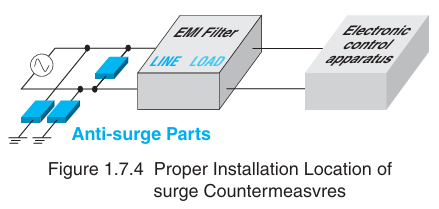
This type of noise occurs when a natural discharge, such as lightning, affects a power line. Because the generated voltage can reach extremely high levels-sometimes several kilovolts or more-EMI filters alone cannot suppress surge noise. As a countermeasure, components such as varistors can be used to control surge voltage either between power lines or between a power line and ground.
EMI filters can typically withstand approximately 2 kV between power lines and approximately 4 kV between a power line and ground, though these values are not guaranteed. If surges are a concern, appropriate surge-protection measures should be selected and installed in accordance with the EMI filter’s capabilities.