
(1) CE Marking
For machines and electrical products sold in the EU, manufacturers are required to affix the CE mark to show compliance with safety requirements, quality control, and environmental protection. To do so, the products must comply with the applicable EC directives.
The following summarizes the EC directives that apply to general machinery products:
a. Machinery directive
This directive applies to products consisting of assemblies of parts that include a drive system, with a primary focus on industrial machinery.
b. EMC directive
This directive applies to electrical equipment that can generate electromagnetic disturbance or be affected by it. It requires compliance with two aspects: emission (EMI) and immunity (EMS).
c. Low voltage directive
This directive applies to products that operate with a rated voltage between 50 and 1000 V AC, or between 75 and 1500 V DC.
Because no EC directive (including those listed above) applies to EMI filters, EMI filter products cannot carry the CE mark.
However, EMI filters can obtain the ENEC mark, which provides similar advantages in terms of reduced approval procedures among participating countries.
(2) Conducted Emission EN61000-6-4
The voltages of interfering waves conducted through a power cable from the equipment to the outside are measured using an LISN★ in an open-area test site (OATS)★ or an anechoic chamber★.
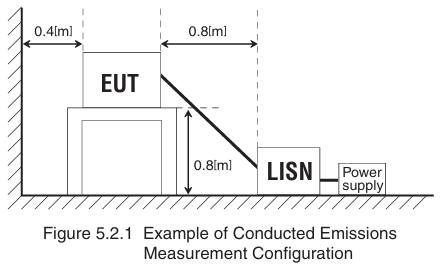
★: Refer to the description in “Terminology Related to EMC Tests” in this document.
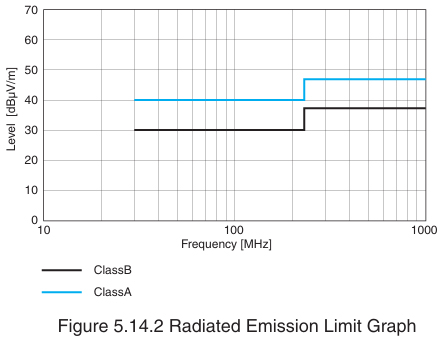
(3) Radiated Emission EN61000-6-4
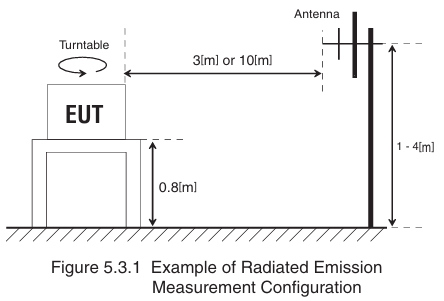
When operating the equipment, the strength of the electromagnetic waves is measured over a specified frequency range at a distance of 3 m or 10 m from the equipment.
(4) Power Supply Harmonic Current EN61000-3-2
The frequencies of the input current are analyzed, and the harmonic current for each order is verified.
(5) Electrostatic Discharge
This test simulates the effects of electrostatic discharge (such as malfunctions or damage to semiconductor devices) and includes both contact discharge and air discharge.
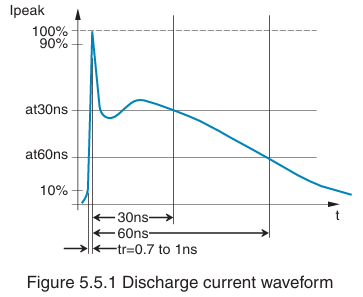
Table 5.5.1 Application Level
| Level | Specified voltage | First peak discharge current (±10%)Ip |
Rise time | Current value at 30 ns (±30%) |
Current value at 60 ns (±30%) |
|---|---|---|---|---|---|
| 1 | 2kV | 7.5A | 0.7~1 ns | 4A | 2A |
| 2 | 4kV | 15A | 0.7~1 ns | 8A | 4A |
| 3 | 6kV | 22.5A | 0.7~1 ns | 12A | 6A |
| 4 | 8kV | 30A | 0.7~1 ns | 16A | 8A |
(6) Radio frequency electromagnetic field EN61000-4-3
This test evaluates the immunity of equipment to electromagnetic waves.
(7) Fast Transient/Burst EN61000-4-4
This test evaluates the immunity to burst pulses by injecting cable‑coupled pulses that simulate the effects of a discharge.
(8) Surge EN61000-4-5
This test verifies the immunity to surges by injecting the specified surge into the input lines.
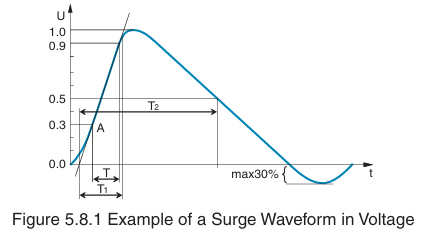
Table 5.8.1 Level
| Level | Open circuit test voltage ±10%[kV] |
|---|---|
| 1 | 0.5 |
| 2 | 1.0 |
| 3 | 2.0 |
| 4 | 4.0 |
| X | special |
(9) Conducted Radio-frequency Interference EN61000-4-6
This test evaluates the immunity to conducted disturbances that are coupled into the equipment through the cables.
(10) Power Frequency Magnetic Field EN61000-4-8
This test evaluates the immunity to power-frequency magnetic fields generated by currents flowing through the input lines or power wiring.
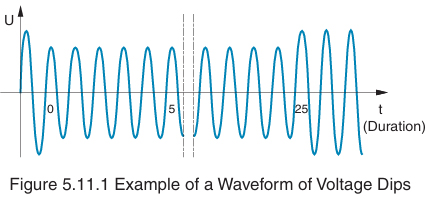
(11) Voltage Dip/Momentary Power Interruption EN61000-4-11
These tests verify whether the equipment operates normally after a momentary voltage dip or a power interruption that reduces the voltage to 0.
(12) Unit of Noise
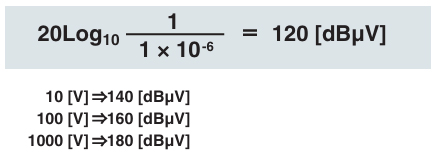
Noise levels are expressed in dB using 1 µV as the reference. A value of 1 µV is defined as 0 dBµV.
For example, 1 V is represented as follows:
(13) Detection Method
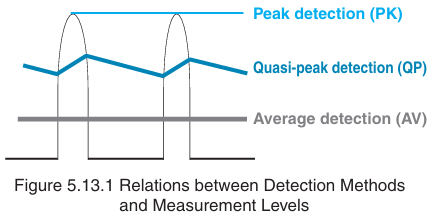
a. Peak detection (PK)
It detects the peak levels of the output waveform.
b. Quasi-peak detection (QP)
It detects quasi-peak values using a circuit with defined charge and discharge time constants.
The quasi-peak value is an intermediate level between the peak and average values.
This method yields higher readings when the noise has a long duration or occurs frequently.
c. Average detection (AV)
It detects the average value of the output waveform.
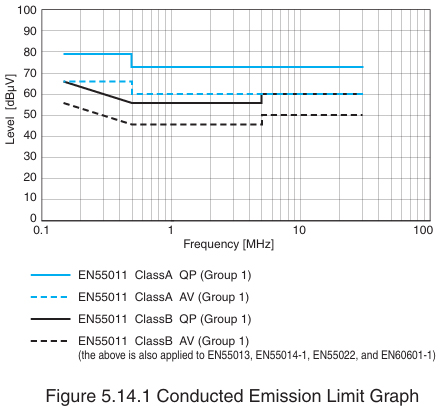
(14) Conducted and Radiated Emission Limits (Excerpt)
| Test item | Standard | EN61000-6-3 | EN61000-6-4 | EN55011 | EN55022 | EN60601-1-2 | EN50370-1 | ||||||||
|---|---|---|---|---|---|---|---|---|---|---|---|---|---|---|---|
| Group 1★ | |||||||||||||||
| Classification | Common standard | Common standard | Standard for product groups | Standard for product groups | Standard for product groups | Standard for product groups | |||||||||
| Product | ― | ― | ISM equipment ★ | Information processing equipment (ITE equipment) | ISM equipment (medical equipment) | Machine tool | |||||||||
| ― | 20 kVA or less | Exceeding 20 kVA | ― | 20 kVA or less | Exceeding 20 kVA | 16A or less | Exceeding 16A | ||||||||
| Operating environment | Class B |
Class A |
Class B |
Class A |
Class B |
Class A |
Class B |
Class A |
Class A |
||||||
Level:Unit [dBµV]
| Conducted emission | Limit | QP | 0.15~ 0.5MHz |
66 ~ 56 |
79 | 66 ~ 56 |
79 | 100 | 66 ~ 56 |
79 | 66 ~ 56 |
79 | 100 | 79 | 100 |
|---|---|---|---|---|---|---|---|---|---|---|---|---|---|---|---|
| 0.5~ 5MHz |
56 | 73 | 56 | 73 | 86 | 56 | 73 | 56 | 73 | 86 | 73 | 86 | |||
| 5~ 30MHz |
60 | 73 | 60 | 73 | 90 ~ 73 |
60 | 73 | 60 | 73 | 90 ~ 73 |
60 | 90 ~ 70 |
|||
| AV | 0.15~ 0.5MHz |
56 ~ 46 |
66 | 56 ~ 46 |
66 | 90 | 56 ~ 46 |
66 | 56 ~ 46 |
66 | 90 | 66 | 90 | ||
| 0.5~ 5MHz |
46 | 60 | 46 | 60 | 76 | 46 | 60 | 46 | 60 | 76 | 60 | 76 | |||
| 5~ 30MHz |
50 | 60 | 50 | 60 | 80 ~ 60 |
50 | 60 | 50 | 60 | 80 ~ 60 |
60 | 80 ~ 60 |
Level:Unit [dBµV/m]
| Radiated emission | Limit | 10m method | 30 ~ 230MHz |
30 | 40 | 30 | 40 | 50 | 30 | 40 | 30 | 40 | 50 | 40 | 50 |
|---|---|---|---|---|---|---|---|---|---|---|---|---|---|---|---|
| 230MHz ~ 1GHz |
37 | 47 | 37 | 47 | 50 | 37 | 47 | 37 | 47 | 50 | 47 | 50 | |||
| 30m method | 30 ~ 230MHz |
- | 30 | - | - | - | - | - | - | - | - | - | - | ||
| 230MHz ~ 1GHz |
- | 37 | - | - | - | - | - | - | - | - | - | - |
(As of November 2011)
★:Refer to the description in “Terminology related to EMC Test” in this document.
(15) Terminology related to EMC Test
★EUT
Stands for Equipment Under Test and refers to the equipment being tested or supplied for testing.
★Immunity test
A test used to evaluate the EUT’s ability to withstand electromagnetic interference.
★Emission test
A test used to evaluate whether the electromagnetic interference emitted by the EUT exceeds specified limits.
★open-area test site
An outdoor test facility used for activities such as EMC measurements.
★Anechoic chamber
A facility designed to create an electromagnetically isolated environment; the interior surfaces absorb radio-frequency waves.
★CISPR
A special committee of the IEC responsible for developing standards related to electromagnetic compatibility (EMC), including limits and measurement methods for radio-frequency interference that can cause disturbances in radio communications.
★Group 1 and Group 2 in EN55011
- Group1 :
- Equipment for laboratories, healthcare, and sciences (Example: frequency counters, spectrum analyzers, switching power source, and measuring apparatus)
- Group2 :
- Industrial induction heating equipment, induction heating equipment, industrial microwave heating equipment, household microwave ovens, medical equipment, spark erosion equipment, and spot welders.
★ISM equipment
Stands for Industrial, Scientific, and Medical radio-frequency equipment. It refers to radio-frequency equipment used in industrial, scientific, and healthcare applications.
★LISN
Line Impedance Stabilization Network:A network that maintains a defined impedance as seen from the EUT’s power lines and extracts conducted noise components to be measured by test instruments. It is also called an Artificial Mains Network (AMN).