
1. What is heat cycle test?
A heat cycle test is used to evaluate how repeated temperature changes affect a power supply.
There are several reasons why a heat cycle test is necessary.
- (1)The sample is composed of different materials, each with a distinct thermal expansion coefficient. In this situation, stress can develop at the interface between the materials, potentially leading to power supply failure.
- (2)Similarly, solder joints may crack due to differences in thermal expansion between internal components and the printed wiring board, which can result in power supply failure.
In the case of a power supply, the influence of factor (2) is greater. Therefore, we focus on the solder joint condition during the thermal cycling test.
The durability in a heat cycle test depends on the following factors.
- (1)Test temperatures (low/high)
- (2)Exposure time at low and high temperatures
- (3)Temperature ramp rate between low and high temperatures
- (4)Number of test cycles
- (5)Amount of thermal conduction to/from the inside of the power supply
2. Test Conditions for the Temperature Cycling Test
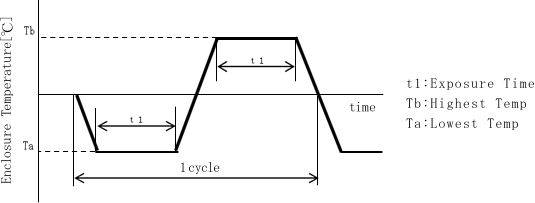
The general conditions of the temperature cycling test are shown below.
- (1)Highest Temp. [Tb] : 125℃
- (2)Lowest Temp. [Ta] : -40℃
- (3)Exposure time [t1] : 30 minutes each
3. Lifetime Estimation of the Solder Joint
The lifetime of the solder joint under actual operating conditions can be estimated based on the Coffin–Manson method.