
1. The different types of noise
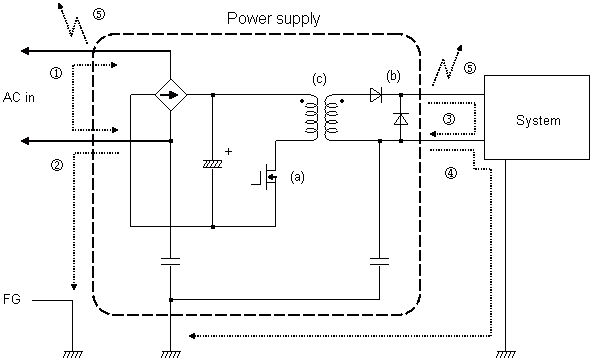
The noise generated by the power supply is classified into several types based on their propagation paths.
There are two main types of electrical emissions generated in power supply--conducted emission and radiated emission.
(1) Conducted noise
- i.Input side (Line conduction)
- Differential-mode noise ----- ①
- Common-mode noise ----- ②
- ii.Output side
- Differential-mode noise ----- ③
- Common-mode noise ----- ④
(2) Radiated noise (Radiated emission) ----- ⑤
2. Countermeasures for noise occurring from the power supply
2.1 Countermeasures for conducted noise
- (1)Countermeasures for line conduction
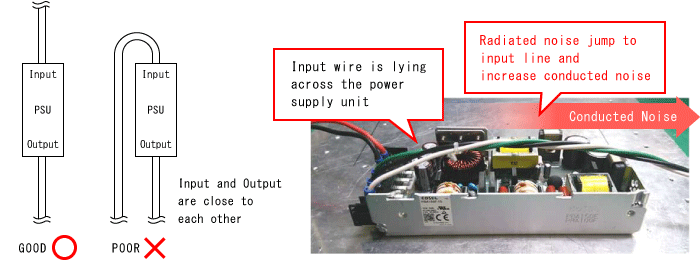
The power supply includes an internal noise filter that prevents noise generated within the unit from returning to the input side. To maintain the effectiveness of the noise filter, please ensure that the output and input lines are kept separate during wiring. Additionally, to minimize the impact of radiated noise on the input line, route the input line away from the power supply.
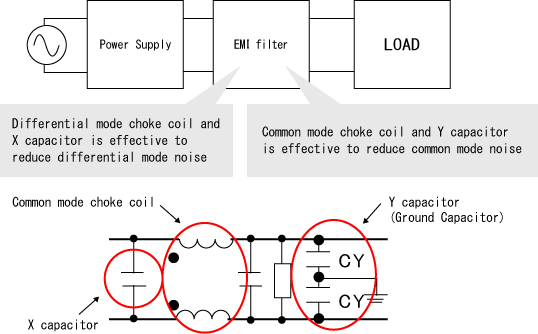
Furthermore, to reduce noise radiated from the power supply and to mitigate noise effects caused by long input lines, it is recommended to install an external noise filter at the AC terminal of the unit case.
- (2)Countermeasures for output noise
It is important to wire the power supply using thick and short cables. Both differential-mode noise and common-mode noise can be reduced by adding a capacitor or a filter to the output line.
2.2 Countermeasures for radiated noise (Radiated emission)
Noise can emitted as radio waves through cables such as the input line, output line, and signal line extending outside the unit, which act like antennas.
For this reason, it is important to first implement measures to prevent noise conduction along the input and output lines. If these measures prove insufficient, additional components such as noise filters or data line filters should be used. If the enclosure is not made of metal, using a metal plate or metal film inside the power supply enclosure can also be effective in shielding noise generated by the power supply.
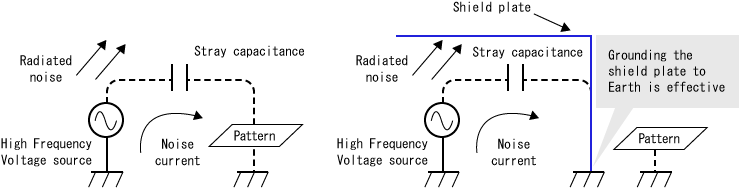
Radiated noise from the power supply often includes high-frequency components, and the effectiveness of shielding depends on the installation and environmental conditions. Ideally, the power supply and the application chassis should be connected to the same grounding point. If the power supply and chassis are separate, ground the application chassis via a metal plate. This creates a low-impedance connection between the power supply and the application, reducing the influence of noise sources.