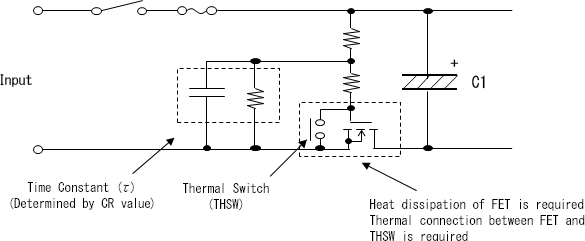
When the input voltage is applied to a power supply, an inrush current flows into the smoothing capacitor, which can cause input switches to melt or fail. To prevent this, an inrush current protection circuit is incorporated into the power supply.
1. Resistor limiting method (Fig.1)
Two methods are commonly used: adding a resistor to the input line or utilizing the impedance of a line filter. However, both methods generate power loss during normal operation and are therefore typically applied only to low-output-power units.

2. Thermistor method (Fig.2)
A thermistor is installed in the input line to reduce inrush current. This method utilizes the characteristics of the thermistor as described below:
At low temperature: Thermistor has a high resistance value.
At high temperature: Thermistor has a Low resistance value.
Description
- (1)When the input voltage is applied, the inrush current is suppressed by the thermistor, which initially has a high resistance.
- (2)As the thermistor temperature increases due to the input current, its resistance decreases, resulting in lower power loss.
Note)
If the input voltage is reapplied before the power supply has sufficiently cooled down, the inrush current may become higher than expected because the thermistor resistance remains low.

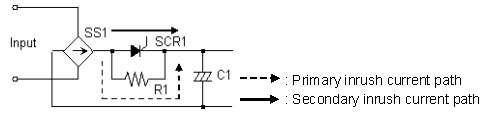
3. Thyristor (SCR) method (Fig.3)
SCR and cement resistor (power resistor) are used in this method.
Description
- (1)When the input voltage is applied (SCR1 OFF), the inrush current flows through the cement resistor (R1).
- (2)After a certain delay, SCR1 turns ON and reduces the power loss in the resistor.
- (3)If capacitor C1 has not fully charged by the time SCR1 turns ON, a second inrush current will occur.
4.DC-DC converter
In most DC-DC converters, an input smoothing capacitor (C1) is not included, and therefore an inrush-current protection circuit is generally not provided. However, if the input voltage rises very rapidly, or if a mechanical switch is used for power ON/OFF, a short-duration inrush current (lasting a few microseconds) may still occur.
If an external capacitor is used before the DC-DC converter, the inrush-current protection circuit shown in Figure 4 is effective in reducing inrush current.