
Over-Current Protection (OCP) is a function that protects the power supply and the load from damage caused by output current exceeding a specified limit. Please find below an example of the mechanism of an over-current protection (OCP) circuit, as well as important precautions for its use.
1. Mechanism
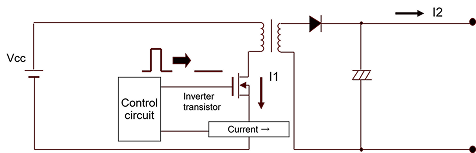
- (1)The mechanism of the over-current protection circuit is as follows:
①The load current (I₂) exceeds the specified limit, creating an over-current condition.
②The current I₁ increases in proportion to I₂.
③The control circuit detects the over-current condition by monitoring I₁, which is converted into a voltage by the current transformer.
④The output voltage is reduced by controlling the inverter transistor.
- (2)The over-current protection circuit also provides short-circuit current limiting.
- (3)After the over-current condition is cleared, the output voltage automatically returns to its original state (excluding some models).
*If the power supply is operated continuously under over-current conditions, it may cause a failure of the power supply or shorten its lifetime.
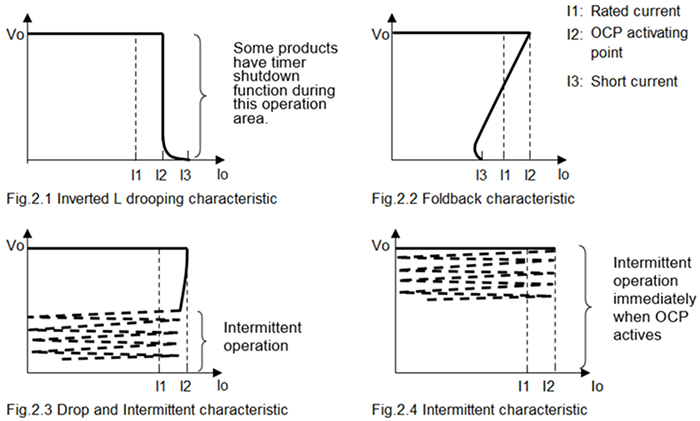
2. Over-current protection characteristics (i.e. Load characteristics)
3. Loads that Prevent the Power Supply from Starting Up
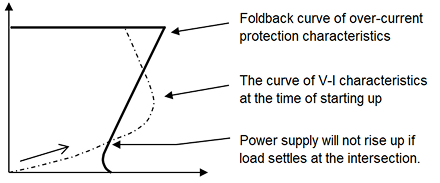
A power supply with a fold-back type over-current protection circuit may fail to start up when driving loads such as lamp loads, motor loads, constant-current loads, or constant-voltage loads (e.g., DC/DC converters).
(1)Mechanism
The reason why the power supply fails to start up is that the output settles at the point where the load’s transient V-I characteristic curve intersects the fold-back over-current protection curve.
(2)Confirmation of symptoms
If the power supply does not start up, it is possible that the overcurrent protection circuit is operating. In this case, first check the output voltage with the load disconnected. If the output voltage rises to its normal level when the load is removed, the overcurrent protection is likely being activated.
In such cases, it may be necessary to increase the power supply capacity or switch to a power supply that supports constant‑current operation.
If the load-side DC-DC converter has a remote-control function, the issue may be resolved by starting the DC-DC converter via remote control after the output voltage of the power supply has reached its rated value.
Please check the input current of the DC-DC converter and consider this option accordingly.