1. Parallel operation
Parallel operation is a method of increasing output power by connecting multiple power supplies in parallel to compensate for insufficient output from a single unit. When operating power supplies in parallel, it is generally recommended to use units equipped with a parallel operation (current-sharing) function. However, for power supplies that do not have a built-in parallel operation function, parallel operation may still be possible by using the “-P” option or by installing diodes as a simpler method.
2. Redundancy operation
2.1 Redundancy operation
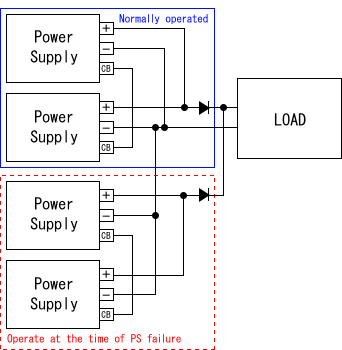
Redundancy operation, also referred to as backup operation, is similar to parallel operation in that multiple power supplies are connected in parallel. However, its purpose is not to increase output power. Instead, redundancy operation provides a backup power supply to ensure that the system continues operating even if one power supply fails.<br>When implementing redundancy operation, it is generally recommended to use a backup power supply with the same rated current as the main unit. Additionally, if the system also uses parallel operation, the same number of power supplies is required. See Fig. 2.1 for details.
2.2 N+1 Parallel Redundancy operation
In conventional redundancy systems, an equal number of additional power supplies is required (see Fig. 2.2).
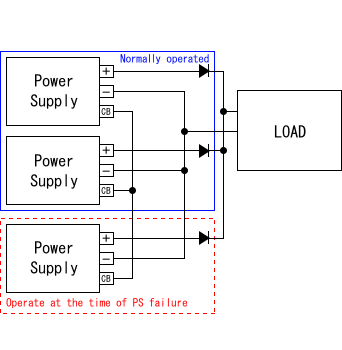
In contrast, N+1 parallel redundancy operation distributes the system load across multiple power supplies and includes one additional unit as a redundant backup. This approach is often more cost‑effective, particularly in high‑power applications, for the following reasons:
- *Redundancy is achieved by increasing the number of power supplies and sharing the total system load.
- *One power supply serves as a backup unit to ensure uninterrupted system operation in the event of a power supply failure. In this case, the backup unit does not need to have the same full output capacity.
If a power supply equipped with a current‑sharing function fails, the system voltage may drop because the failed unit delivers 0 A while the remaining units attempt to equalize current.
Please refer to the product manual and follow the recommended usage instructions.