
Please keep the following in mind when choosing a circuit breaker to protect the input circuit of switching power supply.
1. Number of Poles
How to Select a Circuit Breaker
There are two power lines, AC(L) and AC(N), with AC(N) at earth potential.
If AC(L) and AC(N) can be clearly identified, a single-pole circuit breaker can be used to disconnect only the AC(L) line.
However, if AC(L) and AC(N) cannot be reliably distinguished, a two-pole circuit breaker must be used to disconnect both lines.
For Three-Phase Power
A three-pole circuit breaker is required to disconnect all phases.
2. Trip characteristics and rating
In general, the input circuit of a switching power supply uses a capacitor-input configuration. As a result, when power is applied, a large surge current-referred to as inrush current-flows instantaneously. Although this inrush current lasts only for several milliseconds (ms), its magnitude can be up to ten times higher than the normal input current. Depending on the trip characteristics of the circuit breaker, it may trip in response to this inrush current. Therefore, the circuit breaker should be selected so that it does not trip due to a short-duration inrush current; such breakers are commonly known as “slow-blow” types.
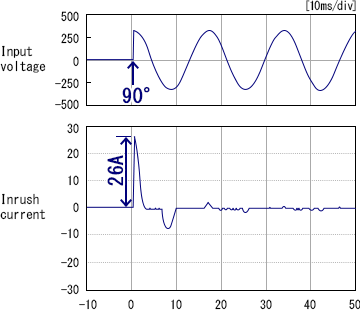
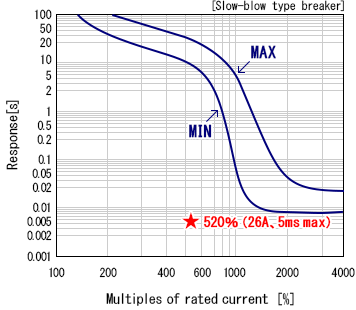
The area enclosed by the two curves represents the operating range of the circuit breaker. Assuming an inrush-current duration of 2 ms, the graphs above indicate that this condition falls outside the operating range of the circuit breaker.
Considering the input characteristics of a switching power supply, a peak inrush current occurs when the input-voltage phase is at 90° or 270°. This current flows through the circuit but decays to 0 A within a maximum of 5 ms.
Based on the inrush-current values listed in our catalogue, a circuit breaker that does not operate within 5 ms should be selected. In addition, the listed inrush-current values are measured at the rated input voltages—typically 100 VAC and 200 VAC. If the power supply is operated at an input voltage higher than the rated value, the inrush current should be adjusted by multiplying the catalogue value by the ratio of the actual input voltage to the rated voltage (100 V or 200 V). For example, if the input voltage is 220 V, the multiplication factor is 220/200 = 1.1.
In addition to the above considerations, the operating temperature must also be taken into account. The selected circuit breaker should not trip even when the power supply is operated at the maximum specified operating temperature.
Finally, careful attention should be paid to the power-supply fuse, as the circuit breaker may not operate if the power supply fails due to a blown fuse.