
-
We applied a standard noise filter to reduce the conducted noise generated by a servo motor. However, the low-frequency conducted noise exceeded the required regulatory limits, and we are struggling to find an effective solution.
Although adding an external core would improve the noise performance, the shipment deadline is approaching and there is not enough time to evaluate the mounting method, wiring method, or make mechanical design changes.
Is there an effective countermeasure under these constraints?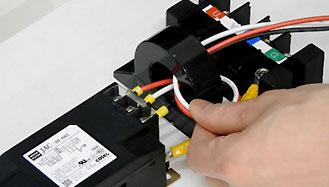
Wiring man-hours 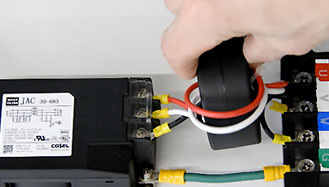
Fixing the external core 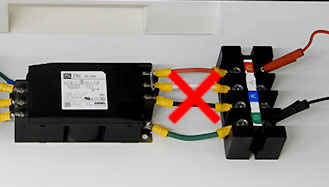
Secure space external core -
The issue may be caused by common-mode noise. In this case, the H option, which provides enhanced common-mode attenuation characteristics, is effective.
This option has the same external dimensions as the standard product, so no mechanical modification is required.
Cause
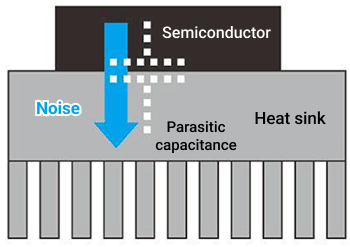
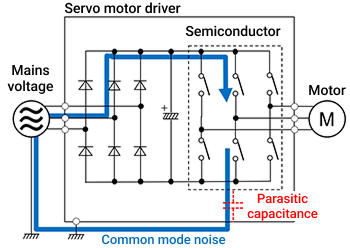
Inside the servo driver, power semiconductors perform switching operations for power conversion. These semiconductors generate heat and are cooled by heat sinks, which are connected to the chassis. As a result, the switching operation induces noise current that flows into the chassis, appearing as common-mode noise externally.
The switching frequency typically ranges from a few kHz to around 20 kHz, and its harmonic components become noticeable as common-mode noise around 150 kHz.
Solution
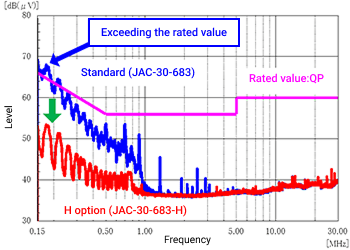
Using the H Option provides significantly higher attenuation of low-frequency common‑mode noise.
The H Option offers the following advantages:
-Same external dimensions and mounting pattern as the standard product
-No need to add external cores
-No mechanical modification required
Therefore, simply replacing the standard filter with the H Option enables effective noise reduction.
Commentary
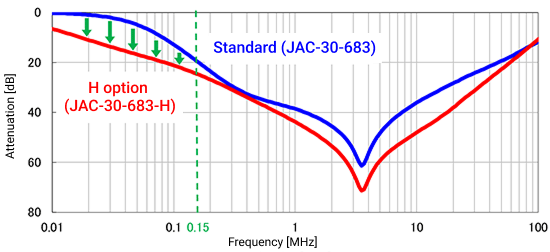
(1) Comparison of Attenuation Characteristics
Compared with the standard model, the H Option provides improved low‑frequency common‑mode attenuation, achieving performance equivalent to or better than the standard model with external cores.
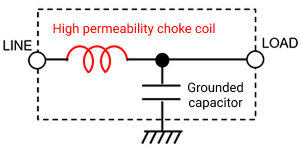
(2) Common-Mode Equivalent Circuit
[Standard Model]
The noise filter consists of a choke coil and Y‑capacitors, forming an L‑type low‑pass filter that suppresses common‑mode noise.
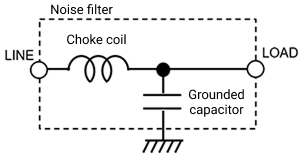
[H Option]
The overall circuit structure is the same, but it uses a high‑permeability choke coil with higher inductance, which enhances low‑frequency attenuation.
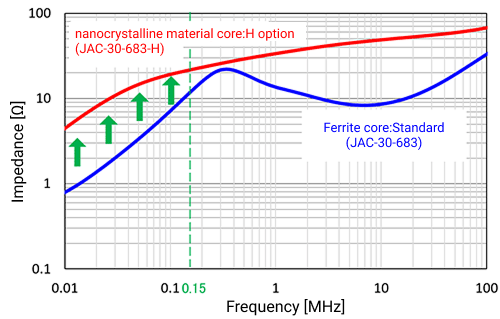
(3) Impedance Characteristics Comparison
Choke coil core materials:
Standard model: Ferrite core
H Option: Nanocrystalline core
Nanocrystalline cores offer much higher permeability than ferrite. This results in higher impedance from low frequencies, providing superior attenuation of common‑mode noise.
Key Point
For large systems that use multiple servo motors, even higher‑performance noise filters may be required.
For details, please refer to the example in "Servo motor noise countermeasures: Step 2 Countermeasures against noise filter saturation."
The following series support the H option.
-
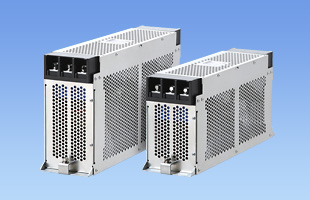
FTB series

Three-phase 500VAC 80-150A
Book type
High-attenuation from 150kHz to 1MHz
2-stage filter -
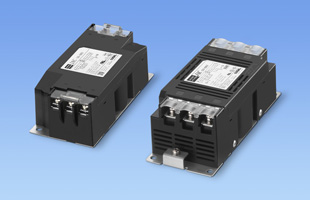
JAC series
Three-phase 500VAC 6-60A
Compact and low profile
High-attenuation from 150kHz to 1MHz
1-stage filter -
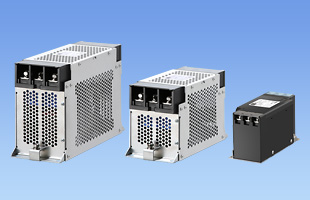
FTA series
Three-phase 500VAC 40-150A
General-purpose Book type
High-attenuation from 150kHz to 1MHz
1-stage filter -
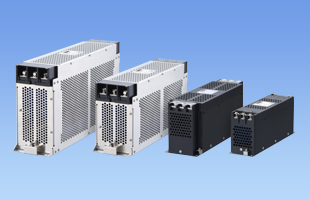
FSB series
Three-phase 500VAC 10-150A
Book type
EMI/EMC Filter for motor drive system
2-stage filter
- ※For other series, please contact us.