Q&A(FAQ) How can pulse/peak current be drawn?
A pulse load refers to a load in which the current changes in a pulsed manner. Examples include stepper motors used in printers or scanners, print heads, LED drivers, SSDs (Solid State Drives), and similar devices. Pulse loads do not pose a problem as long as the peak current does not exceed the rated current of the power supply.
[How to Handle Pulse / Peak Current]
In general, a power supply cannot continuously provide current exceeding its rated output. However, short-duration peak currents are permissible under certain conditions:
(1) Peak current time of several microseconds (μs)
The peak current can be supplied from the power supply’s internal capacitor. Please contact us for detailed information regarding specific applications.
(2) Peak current time from several microseconds (μs) to several milliseconds (ms)
The peak current can be supplied if an external capacitor is installed. The required capacitance of the external capacitor can be calculated using the following formula:
If the capacitance of the external capacitor is too large, the power supply may fail to start up. Since the maximum allowable capacitance varies by model, please refer to the specifications of each product.

*Please consider the rated ripple current of the external capacitor.
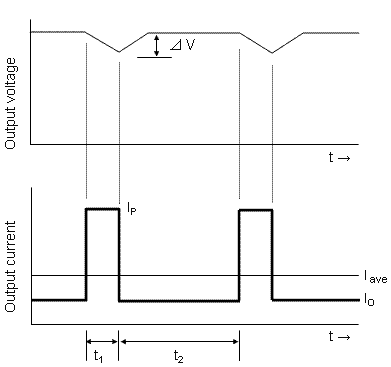
*Output current should meet the following.

(3) The case that the peak current time is several ms or more
For some models, peak-current-capable power supplies are available-such as versions supporting 1.5 × peak current or 10 second peak durations (optional -H specification). For details, please refer to product page.