Q&A(FAQ) Why does LED light during Withstand Voltage Test?
1. Generation mechanism
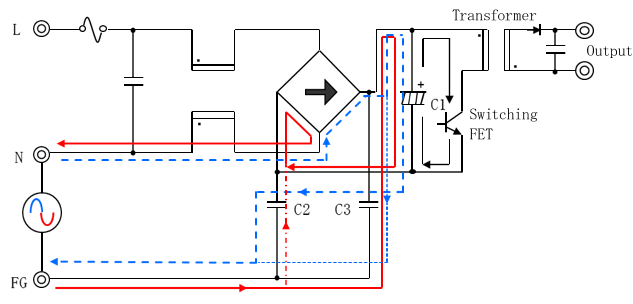
When a test voltage is applied between the input and FG, a charge is accumulated in capacitor C1 through the grounding capacitors C2 and C3. When this charge voltage exceeds the startup voltage of the switching power supply, the inverter circuit (TR1, OT) begins operating and generates an output voltage. However, because the amount of charge accumulated in C1 is very small, the operation stops almost immediately.
While the test voltage is being applied, this process repeats, causing pulse-shaped voltage to appear at the output. Since the circuit operates in a controlled manner, the output voltage never rises above the rated voltage. In addition, no abnormal voltage is applied to internal components of the power supply, so there are no reliability concerns.
In power supplies with a built-in LED, the LED will emit light in response to the above output voltage.
2. Impact on Output Load Equipment
The output voltage will not exceed its rated value, so the impact on devices connected to the power supply output is minimal.
However, depending on the characteristics of the connected equipment, additional precautions may be necessary.
In such cases, please short the output terminals of the power supply during the test.