Health and Productivity Management
Health and Productivity Management Initiatives
Health Management Declaration
COSEL Health Management Declaration
Employees' health is the foundation of sustainable corporate growth. That is why we have made creating an environment and providing support to promote health a top priority. Based on our firm belief that people are a company’s most valuable asset, we pledge to foster a workplace where every employee is mentally and physically healthy and can work with enthusiasm.
October 21, 2025
President & Chief Executive Officer
Morio Saito
Main Initiatives
Safe workplace
We work to create a workplace free of anxiety that hinders psychological safety, where everyone feels comfortable to express their ideas.
Exercise, diet, and mental care education and support
We provide a diverse range of support related to exercise, diet, and mental care to increase health awareness.
100% follow-up exam participation rate
When an employee’s annual health checkup results indicate the need for more detailed tests, we encourage them to schedule an appointment.
Health data-based preventive support
We visualize health issues and implement improvement measures for employees based on health checkup, stress check, and other data to prevent future health risks.
Second-hand smoking prevention
We implemented clear rules on smoking in company cars in consideration of its impact on health and our corporate social responsibility.
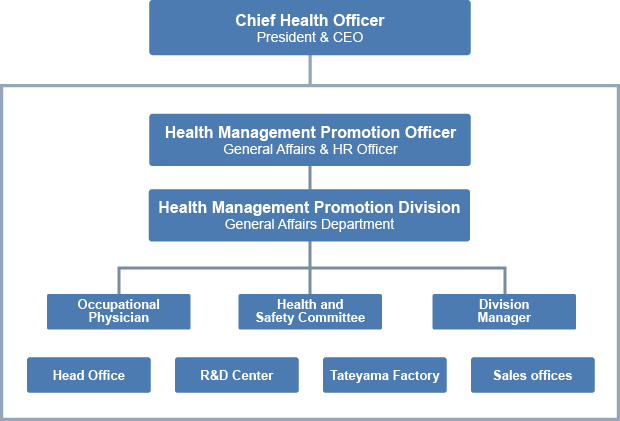
Health Management Organizational Structure
The President and CEO serves as the Chief Health Officer and the executive officer in charge of general affairs and human resources serves as the Health Management Promotion Officer. The Health Management Promotion Division centrally drives health management.
Leave systems
COSEL has introduced the following leave systems to improve employees’ work-life balance.
Family care leave/time off
Employees caring for family members who require long-term care can take family care leave/time off (including hourly time off) in accordance with the terms and conditions of these programs.
System for maternity leave before or after childbirth, childcare leave, and childbirth leave (leave for fathers after childbirth)
Our in-house rules clearly describe such systems as those for maternity leave before or after childbirth and childcare leave. Childcare leave may be taken until the last day of the month following the month in which the child reaches the age of two years.
Childbirth leave (leave for fathers after childbirth) may be taken for up to four weeks (which may be divided into two periods) during the period until the day after the eighth week following the date of birth.
Child nursing-care leave
An employee caring for a child in the sixth grade of elementary school or younger may take child nursing care leave (including hourly leave). Child nursing care leave, which is separate from annual paid leave, is intended for uses such as caring for an ill or injured child, vaccinations, or health checkups.
Encouraging employees to take paid leave systematically
We encourage employees to take paid leave based on in-house rules that require them to take two days of their annual paid leave per half-year on a planned basis.
We will continue to encourage employees to take paid leave systematically. This is intended to help balance work and home life, encourage self-improvement, and provide opportunities for rest and relaxation. We will check on the achievement of this aim by collecting periodic reports on taking leave.
Accumulated healthcare leave
Employees may take up to 20 days/year in leave for (i) personal injury or illness and (ii) short-term childcare, family care, or nursing care.
Refreshment leave
Employees may take refreshment leave days for the number of days corresponding to their years of continuous service in milestone years. This leave is intended for mental and physical refreshment purposes (including recognition of their service, health maintenance and improvement, and enrichment of home life).
Consideration for working hours
Flextime system
We employ a flextime system so that our employees can work efficiently while maintaining harmony between their work and personal lives.
No-overtime day
COSEL has designated Wednesday of each week as no-overtime day in which employees are encouraged to make time available for pursuing hobbies, learning new things, and spending time with their families.
Shortened working hours for childcare
We encourage employees caring for children in the sixth grade of elementary school or younger (until March 31 of the child's sixth-grade year) to use this program, which enables them to work shortened working hours in accordance with the provisions of the flextime program.
Industrial health and safety
In accordance with the Industrial Safety and Health Act, we have established a Safety and Health Committee at each COSEL plant in Japan to engage in activities related to health and safety. Committee members appointed from each department strive to prevent accidents on the job and improve health and safety conditions in the workplace, aiming for a goal of zero on-the-job accidents.
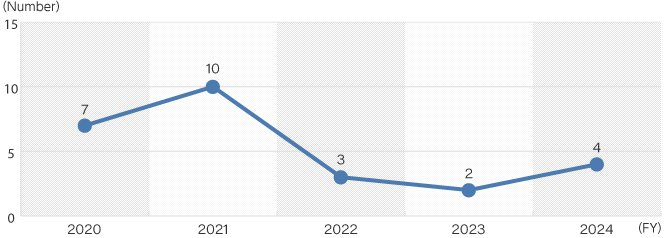
Unfortunately, the number of industrial accidents shifted to an increasing trend in FY 2024. No general trends were apparent in the details of the accidents. We responded by implementing preventive measures individually, publicizing and raising awareness of the accidents across the organization, and making additions to health and safety educational materials.
We will continue efforts toward the goal of zero on-the-job accidents in the future as well.
< Number of on-the-job accidents >
Health management
Excessive workloads, such as extremely long working hours, may exacerbate such health problems as cerebrovascular and heart conditions. COSEL asks employees working excess overtime to meet with industrial physicians. Through these efforts, we strive to prevent health issues caused by work.
To promote early detection and raise awareness of women's health issues, COSEL pays a subsidy equivalent to one-half of the costs of medical examinations for women aged 25 and older.
Twelve employees used this system in FY 2024.